

The Constraint Method: Why Aiming for Performance Accelerates Decline

How do we juggle it all? I need to run fast AND far. I need to maintain my strength, be able to jump, shuttle, increase muscle mass, and hit some high intensity circuits.. Did I mention I’m out of time to increase mobility, nurture old injuries, let alone explore new ideas? There are so many fitness standards to stay on top of — and new ones being sold to me every day — where does it all fit?
This isn't a time problem, or even trying to hit the right performance metrics. The problem is in aiming for "performance" before you have established what you are deficient in. The main complaint I hear from my clients, when teaching them to coach themselves, is something rather simple: they don't know what to do at the gym. They feel overwhelmed with the complexity of training because they are trying to emulate someone else’s performance, someone else's plan; who seems to have it figured out. This is most people — and yet we can also say in the very next sentence how individualized training should be. Your problem is unique to you. Not only has no one ever shown you how to find the problem, they are most often selling you a fix to the wrong one.
If that describes you — confused in knowing how to train, select exercises, progressions, or just unmotivated to put proper sessions together, and that confusion means you train less frequently, less effectively, or makes injury and burnout more common — I promise if you make it through this article, I can help.
The fitness industry is in a quiet crisis. The crisis is that most of what the public has been taught about training was never designed for them. The models they follow were built for athletes whose job is to win — not for people whose job is to last. The majority of us who are using fitness to be generally better are using specialization to do it. And it isn't working.
The performance model — the framework that dominates gyms, apps, certifications, and social media — asks a simple question: can you do more? More weight, more reps, a faster time, a higher output. And the answer, for a while, is always yes. That's the trap.
Performance, defined honestly, is above-average output or efficiency in a specific task—a designated pattern or series of patterns. Achieving it requires the body to borrow. Resources get funneled toward the demands being placed on the system, and away from everything that isn't being asked to contribute. This is specialization. It is the engine of athletic achievement. And for anyone who is not a competitive athlete, it is the mechanism of long-term physical decline.
The person who singularly chases a heavy squat develops hip restrictions, because a squat does not require a full range from the hip. "Requesting" to be stronger in the range required for squatting will mean narrowing the resources — in internal/external rotation — from the joint's orientation not being utilized. Further, competition often places standards that minimize range such as going to parallel in a squat. What we call "full range" by competition standards is not full range in individual standards. The runner who builds mileage loses upper body tissue and range, it just takes longer to see because the contraction rate is a lesser signal. The CrossFitter who trains "everything" actually trains a narrow band of patterns at unvaried intensities, often falling victim to interfering signals which leave fundamental capacities — true endurance, true strength, real mobility — undeveloped. The metrics go up. The body goes sideways.
This article lays out an alternative. Not a program. Not a brand. A method — a way of thinking about training that starts with what's missing rather than what's impressive.
The Problem with Borrowed Models
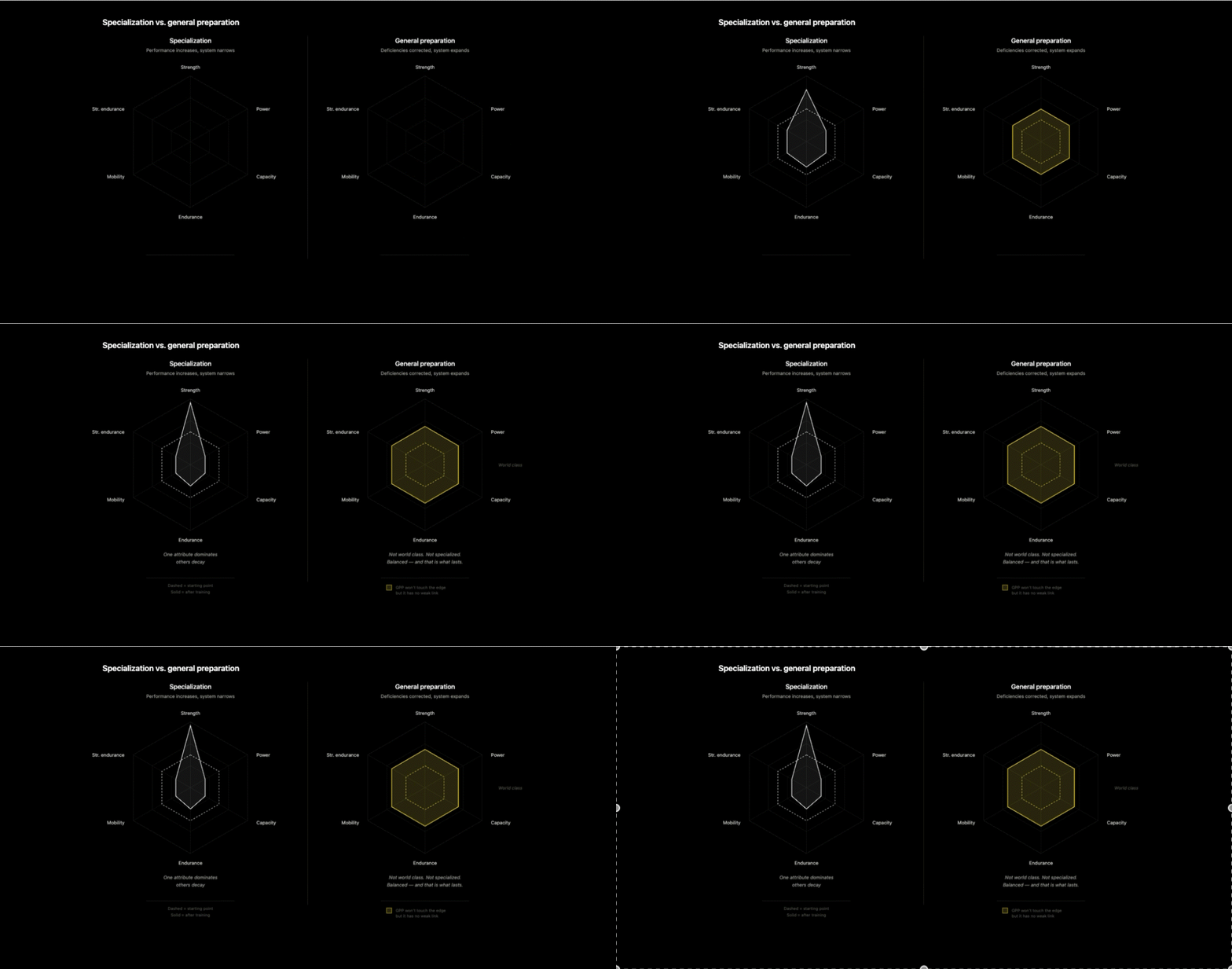
The fitness industry did something remarkable over the past thirty years: not only did it push the boundaries of human capability (barely), it also convinced the general public that the methods of the elite trickle down to general adaptation. The theory is that we should all train for performance, it is "little league" indoctrination and major league delusion. Periodization schemes designed for Olympic lifters got handed to office workers. Interval protocols built for track cyclists are now lunchtime classes. If you drop into most "functional" training gyms around the world, the chances are that the programming follows something similar to a CrossFit Games athlete, a blend of progressive weightlifting followed by an interfering amount of circuit work. This is thought of as aspirational, cubicle warriors spending their afternoons training like Rich Froning. The language of sport science — progressive overload, peaking, "conjugated periodization with cyclic emphasis" — became the vocabulary of general fitness. Not only do most people not understand it, your body doesn’t speak it.
This was never appropriate. Elite athletes are solving a fundamentally different problem. They need to maximize output in a narrow domain, for a short competitive window, with a support team managing the damage. They expect to specialize. They accept the cost. Their entire infrastructure — coaching, recovery, medical support, offseason protocols — exists to manage the compensations that specialization creates.
The general public has none of that infrastructure and none of that need. They don't need to peak. They don't have an offseason. They need a body that works well across every demand life places on it, for decades. And the model they've been given does the opposite — it narrows them, unevenly, while telling them they're getting fitter.
This is compounded by a distinction the industry rarely makes: brands are not training methods. The fitness landscape is dominated by brands that position themselves as methodologies. A brand is a delivery system — a way of packaging and selling exercise while associating with athletes, sports, and supplements. The question is whether the underlying methodology actually serves the person's long-term physiological development, or whether it serves the need to retain members through novelty, notoriety, and a sense of common belief.
CrossFit is the clearest case. It presents itself as the answer to specialization — broad, general, inclusive fitness. In practice, it is a sport disguised as GPP. The competitive structure, the benchmark workouts, the leaderboard culture all drive the same behavior that any sport drives: people optimize for the test. They chase Fran times and clean PRs and muscle-up volume. The programming is varied in exercise selection but narrow in demand — it lives almost entirely in the high-output, glycolytic window, with a heavy bias toward a small set of sagittal movement patterns performed under fatigue. But the cracks come through when it comes time to use the methodology to access and fix a deficiency, that's because their answer, like most sports, is to just do more. This is not general preparation or training that can consider the individual. It is specialization with a wider exercise menu — and its own tagline confirms as much. You cannot be "the sport of fitness" without the specialization that sport demands. That is not GPP. It is competition wearing GPP's jersey.
The "hybrid athlete" movement commits a similar error. It takes two specializations — typically strength training and endurance running — and stacks them. The marketing frames this as balance: you're strong and you have endurance. It commits the same grave error as CrossFit but just uses polarized specialization. Stacking two specializations is not the same as developing a balanced system. It is splitting the cost of specialization across two domains. When asked how to fix deficiency? Do more. But you can't stack volume on top of deficiency; it just makes the deficiency worse.
What both models share are examples of extremely impressive feats. But also, a fixation on proving fitness through performance metrics. And that fixation is the root of the problem.
Redefining GPP: Training Away from Deficiency
General Physical Preparedness, in its actual meaning, is the ongoing adaptation of physiology without accommodation. Accommodation is what happens when the body stops responding to a stimulus because it has adapted specifically to that pattern — "efficiency" in competitive sport, but the death of progress outside it. It is the reason programs stop working. And it is the inevitable consequence of repeating the same demands, at the same intensities, through the same movement patterns, regardless of how hard those demands feel. True GPP is the continuous development of all systems without allowing any single system to dominate at the expense of others. Its aim is not to perform, but to address limitations and deficiencies, while acknowledging that accommodation is the limiting factor. This puts a clear focus on the physiology and not on the expression of it through exercises.
True GPP is deficiency-driven. It does not ask "what are the standards?" It asks "what is this person missing?" Not relative to an elite athlete's profile — relative to their own balanced function. Where has their history, their habits, their previous training, their injuries left gaps?
This reframing changes how your training is organized. You are not building toward a benchmark. You are identifying what is weakest and directing resources there. The result — a body with no significant deficits across any major capacity — is, ironically, a body that outperforms the average person who has spent years specializing. Not because it trained for performance, but because it removed the constraints that performance-chasing creates. Which allows the player to "play" for longer. Truly training for GPP is the compound interest of physical training investment—small incremental advancement, long term return.
The Diagnostic Framework
Before you can train intelligently, you need to know what's missing. The Constraint Method uses a simple diagnostic that cuts through the noise.
Step One: System Identification
You are working with two major systems — the muscular system and the aerobic system. Your first question is: which one is deficient? Often both are, but one is almost always more limiting than the other. The person who can deadlift heavy but can't sustain moderate effort for thirty minutes has a different problem than the person who can run for an hour but can't produce meaningful force.
Step Two: Intensity/Duration Orientation
Within whichever system is deficient, you then ask: is the limitation at the top end or at the efficiency end?
Top-end output lives above roughly 70% intensity. This is the domain of maximal effort — how much force can you produce, how much power can you generate, how high can you push your aerobic ceiling. Efficiency lives below 70% — how well can you sustain moderate effort, how effectively does your system operate under submaximal load, how long can you maintain output without decay.
This two-axis framework — system and intensity — gives you four training channels:
Muscular Output — strength and power development. Sessions in this channel are about producing force or producing it quickly. Within this channel, you must further assess whether you are developing range — can you access the positions needed? — or control within range you already have — can you produce force through positions you can reach? This distinction is where most people misidentify their problem, because mobility is not a passive activity separate from strength. Mobility is strength trained through constraint: loading patterns that demand control at end range rather than output through a familiar groove. If you do not have full range in a joint, or lack control within the range you have, that is a muscular output problem — and it must be addressed through the joint specific to the deficiency, not in a separate passive stretching routine. The joints specific to your limitation become the priority. We integrate mobility concepts into most of our sessions but recommend a dedicated track of mobility training as a priority within GPP — it is the prerequisite that makes all other muscular output honest.
Muscular Efficiency — strength endurance and hypertrophy. Sessions here are about sustaining muscular work or building the tissue base that supports it. Hypertrophy is often treated as its own training category, but hypertrophy is an outcome — the adaptation that occurs after fueling and recovery. The training signal that produces it is strength endurance: sustained muscular effort under moderate load, taken to or near failure. Developing lean mass is the foundation to learning how to sense and feel movement. This is the engine room of durability.
Aerobic Output — capacity work. Efforts targeting VO2max, lactate buffering, or a blend. This is your aerobic ceiling — how hard your cardiovascular system can work at its limit.
Aerobic Efficiency — endurance training. Long, sustained, moderate-intensity work that develops the aerobic base, improves fat oxidation, and builds the substrate for all other training.
The exercises themselves are largely irrelevant, with one hard rule: they must not be specialized — a constantly varied selection prevents the accommodation and compensation that fixed programs create. And the higher the intensity, the more variation is required — because high-intensity work with the same movements is the fastest path to accommodation.
Programming: The 9-Day Rhythm

Calling it "programming" is a misnomer, and sets us up for confusion. A program intuits a strict set of boundaries. But as we utilize stress as a positive adaptive force, we must understand that the "program" will change more often than it stays the same. The Constraint Method breaks from the inherited 7-day training week. The work week is an arbitrary social construct that has nothing to do with human physiology. Adaptation doesn't care about weekends, and forcing it through a repeated pattern more often than not blunts the effectiveness of training.
Instead, training is organized in 9-to-10-day cycles. Within each cycle:
6 training sessions. Of these, at least 3 are dedicated to the identified constraint — the deficiency you are actively working to correct. These 3 sessions must be intense enough or include enough duration to require genuine recovery. They are the training signal that forces adaptation.
The remaining 3 sessions are grey area. These can serve multiple purposes: maintaining attributes that aren't the current priority, exploring new movements or modalities, building general work capacity, or simply accumulating volume through base building. These sessions are valuable, but they are not the driver of change. They are supportive.
3 rest or recovery days. Not active recovery dressed up as training. Actual rest. The adaptation happens here, not in the session. However, it does not be sedentary. The habit of including as much “non formal” movement as possible might be one of the most overlooked aspects of longevity.
We leave the cycle open ended by saying 9-10 days. The extra day is a way to increase recoverability or enhance stress. It is to allow for variation.
There is an important distinction between a rhythm and a pattern. A pattern prepares you to repeat. It locks you into a sequence — chest Monday, legs Tuesday, rest Sunday — and the body accommodates to that sequence just as it accommodates to anything else it sees often enough. A pattern is predictable by design, and predictability is the enemy of adaptation without accommodation.
A rhythm is different. A rhythm allows you to oscillate. It has a pulse — work, recover, work, recover — but the pulse is not fixed to an external calendar. It responds. It can expand or compress. Most notably, it has the quality of momentum. A 9-day cycle is a rhythm: you know that within roughly 9 days you will accumulate 6 sessions of training and 3 days of recovery, but when each of those falls, which sessions are intense and which are grey area, and how they're distributed can shift based on how you're responding or feeling on the day.
Attribute Stability
Not all attributes are created equal. Some are slow to build and slow to lose. Others spike quickly and fade just as fast. The Constraint Method programs according to this reality.
Stable attributes: Top-end muscular output (strength) and aerobic efficiency (endurance) are the most stable qualities you can develop. Once built, they persist with minimal maintenance. They also take the longest to develop meaningfully. These must be built first. They are the foundation. In unbalanced individuals — people who have significant strength without endurance, or endurance without strength — correcting this imbalance is the first priority. These corrections happen through long, dedicated blocks: 6 to 9 of the 9-day cycles. Roughly 54 to 81 days of focused work.
Volatile attributes: Power and aerobic capacity are highly responsive but equally fragile. They come up fast with targeted training and drop off fast without it. Once a general foundation of strength and endurance exists, these qualities can be cycled in and out — generally 3 to 6 cycles (roughly 27 to 54 days) before needing to return to maintenance or reload the foundational qualities.
Balanced development: Once a player has corrected their major deficiencies — once strength and endurance are no longer significantly imbalanced and the volatile qualities have been developed to a functional level — a new phase opens. The constraint is no longer a glaring hole. At this point, the player has a choice. They can pursue a degree of specialization if they have a specific interest or goal, doing so now from a foundation that can absorb the cost. Or they can remain in a continuous alternation of training stimuli — rotating between channels, cycling emphasis across qualities, keeping the work exploratory and varied. This is where training becomes genuinely sustainable over a lifetime. Not because it gets easier, but because the player is no longer chasing a fix. They are maintaining a system that works, and the variety itself becomes the safeguard against accommodation. The goal shifts from correcting deficiency to preserving balance — and that is a fundamentally different, and far more enjoyable relationship with training.
This creates a natural long-term rhythm. Long blocks of foundational work, punctuated by short, intense cycles of volatile-attribute development, returning always to the foundation. It's not periodization in the sports-science sense — there's no peak, no taper, no competition to prepare for. It's a tide. It goes out, comes in, and the shoreline moves steadily forward.
What This System Is Not
It's worth being direct about what the Constraint Method rejects, and why.
It Is Not a Brand
A brand packages training for consumption. It needs retention hooks — community, identity, novelty, competition. These incentives are misaligned with long-term development. A system that makes you dependent on its specific classes, its specific equipment, its specific community in order to train is not preparing you generally. It is making you a consumer.
The Constraint Method does not require specific equipment, specific exercises, or specific environments. It requires a diagnostic framework and the discipline to follow it. The system and applied stress is the driver. The body is the vehicle.
Applying the System: How to Use the OLLIN Database
The practical application of the Constraint Method is simple, even if the thinking behind it is nuanced. Here is how it works:
Step 1: Identify your deficient system. Muscular or aerobic? If you're unsure, the answer is usually whichever one you avoid or have never seriously trained.
Step 2: Identify the intensity orientation. Is the problem at the top end (above 70% — you lack output) or at the efficiency end (below 70% — you lack endurance in that system)?
Step 3: Pull sessions that match your identified channel:
Strength — muscular output, heavy loading, maximal effort, and mobility
Power — muscular output, dynamic effort, speed of force application
Strength Endurance — muscular efficiency, sustained work, repetitive effort to failure
Capacity — aerobic output, intervals, VO2max and lactate work
Endurance (Shakeout) — aerobic efficiency, sustained moderate-intensity work
Mobility — range development, active control
Upper / Lower — orientation filters for targeting specific regions
Step 4: Build your 9-day cycle. 3 sessions from your constraint channel. 3 grey-area sessions from other channels or exploratory work, based on interest. 3 rest days. Design an idea and then change on the day according to sleep, stress, and feel. Repeat.
Step 5: Commit to the appropriate block length. If you're building foundational qualities (strength or endurance), stay with it for 6–9 cycles. If you're cycling volatile qualities (power or capacity), plan for 3–6 cycles before returning to maintenance.
If you're an OLLIN member, the Constraint Method interface is already live in your dashboard. It runs the diagnostic and searches the full training library against your result — every session, filtered by the channel you need. This will be expanding every day to include more specificity within the search criteria.
If you're not a member, the diagnostic interface (linked below) runs the same logic and sends sessions matched to your deficiency straight to your inbox. Same method. Same thinking. A focused set of sessions so you can actually train it, and experience what I’m talking about.
The Constraint Method Doesn't Tell You Which Exercises to Do
It tells you what kind of session to seek, based on what you need. The variation in exercise selection is maintained by the OLLIN database itself — as long as you are searching by system rather than by specific movement, the programming stays broad enough to prevent accommodation. Change any exercise or movement, it is unimportant, but stay true to the signal and the intention: aerobic or muscular, efficiency or output.
The fitness industry sells performance because performance is measurable, marketable, and emotionally satisfying. It gives people numbers to chase and identities to adopt. But for the vast majority of the population — people who will never compete, who need their bodies to function well for decades, who cannot afford the compensations that specialization creates — the performance model is a slow-motion injury.
The Constraint Method offers a different proposition. Train based on what you lack, not what you're good at. Organize your time around physiology, not the calendar. Build the stable qualities first. Cycle the volatile ones. Vary constantly. And let the result — a body with no significant weak link — speak for itself.
That body will outperform the specialist in every domain the specialist hasn't trained for. And in a life that demands everything and peaks at nothing, that is the only kind of fitness that matters. The kind that persists.
