

Your Posture Is a History You Didn't Choose
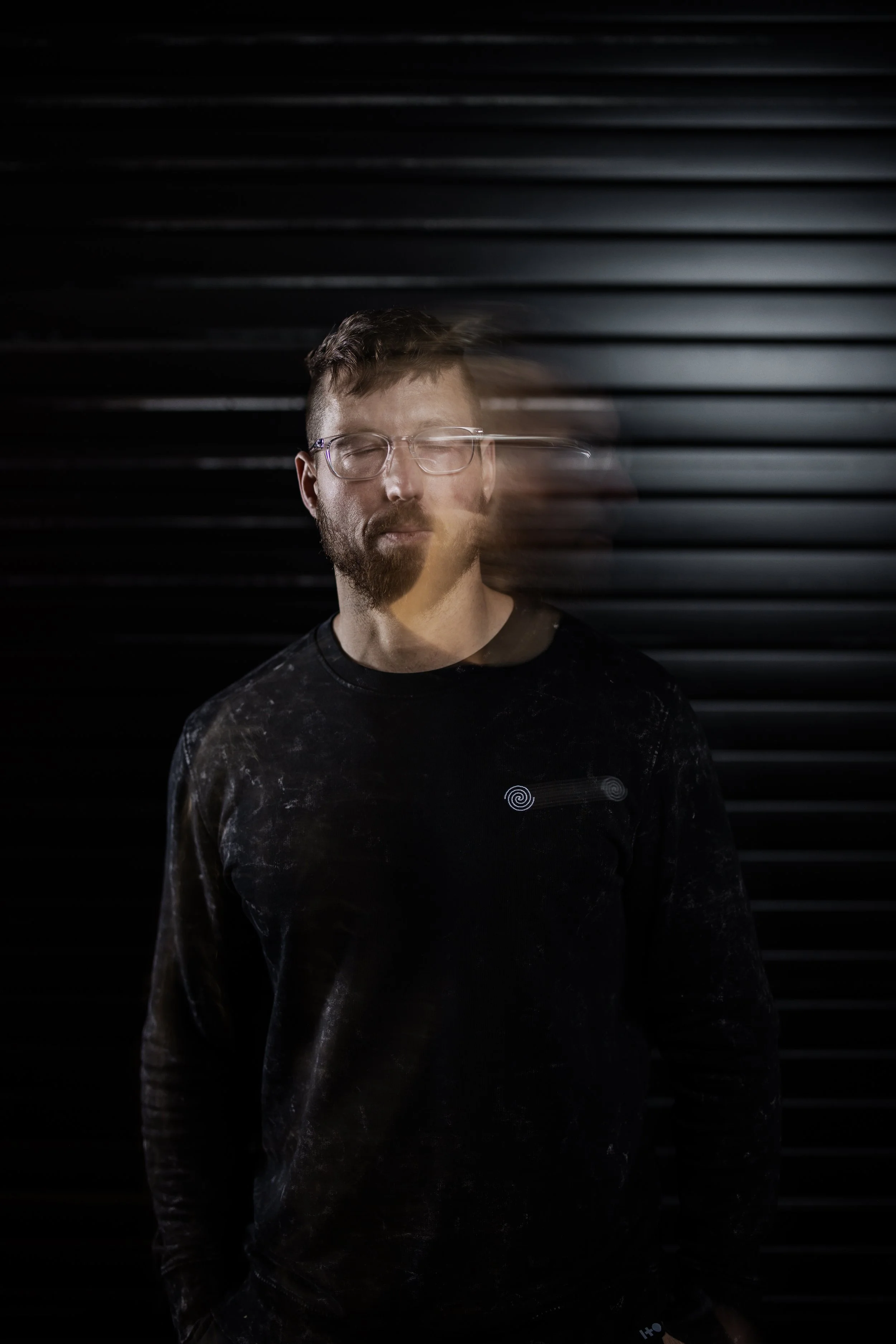
A client stands in front of you and says, "I'm just not an athletic person." He says it the way someone reports the weather — flat, settled, a fact about the world rather than a claim about himself. He is forty-one and he has said some version of this sentence for thirty years. And this is what people get wrong about what they are hearing: they hear a belief and reach for an argument. They pull out the evidence, the before-and-afters, the physiology, the pep talk. They lose. Every time.
They lose because the sentence was never a belief. It was a body describing itself.
The way that man stands — the collapsed chest, the weight back on the heels, the eyes that drop when the room gets loud, the breath held high and shallow — none of it is a habit he picked up. It is thirty years of conditions written into tissue. A childhood where moving badly got him laughed at, so he stopped moving. A field where the athletic kids were a different species and he learned, early and permanently, where the edges of "people like me" were drawn. He did not decide any of this. It decided him, and then it disappeared, the way the most powerful things always disappear: into the obvious.
Habitus is the set of dispositions a person absorbs from the conditions of their life — how they stand, move, perceive, and judge — running almost entirely beneath conscious awareness. The sociologist Pierre Bourdieu called it "history turned into nature." For anyone in the business of changing people, it carries one hard implication: the thing you are actually trying to change was never a belief, a goal, or a deficit of motivation. It is a body, carrying a history, reporting on itself as if it were a fact.
This is why most self-development fails on contact. An entire industry has organized around changing the mind and the mirror — information, mindset, optimization, aesthetics — while the real site of change sits in the body's pre-reflective dispositions, where none of those tools reach. The field of fitness is exceptionally good at producing the appearance of transformation and poor at producing the thing itself.
What is habitus, and why does it belong in a conversation about self-development?
Bourdieu spent his career studying how class reproduces itself — not through money or law, but through bodies. People inherit a way of being in the world: a way of standing, eating, speaking, taking up or yielding space, knowing without being told what is "for people like me" and what is not. He named this acquired-but-invisible disposition habitus, and he was exact about where it lives. Not in the head or as an artifact of societal pressure. In the body. He was mostly commenting about the seperation of classes in society. He noticed how making the money or earning the wealth did not allow you into the same strata in society that can only be purchased through birthright. He noted that one could dedicate themselves to learning the details, how to hold a fork, hold your posture, and wear the right style but still be spotted as an outsider instantly. That’s because the body that grew up poor or striving holds a separate tension and it reads to those who did not; like an unspoken language.
Bodily hexis — habitus made physical — he described as "political mythology realized, em-bodied, turned into a permanent disposition, a durable way of standing, speaking, walking, and thereby of feeling and thinking".
That final clause is the one self-development never absorbed: and thereby of feeling and thinking. The way a person stands is not an expression of how they feel. It is a generator of it. The arrow runs both directions — which means the body is not the output of the self. It is a way into it.
The way someone carries weight is who they are, not a decoration on it, because hexis is bidirectional — posture feeds feeling and thinking as surely as the reverse.
If you have coached anyone or wished that someone you cared about could change, you might wonder: why does more or better information almost never change anyone?
Because dispositions were not installed by information and cannot be removed by it. When a coach explains the correct way to train, or a book hands you the correct way to think, the intervention lands at the level of conscious belief while the habitus underneath keeps generating the old behavior, untouched. This is why the most well-read person and the least informed one often change at the same rate. Knowledge was never the bottleneck.
The industry cannot see this because it has staked everything on the opposite premise — that people fail to change because they lack information or willpower, and the fix is more content, sharper explanations, harder accountability. It is fighting embodied history with a pamphlet, then blaming the reader for not reading it hard enough.
Knowing the right way to live changes a person about as much as reading a map changes the terrain.
The industry of self-improvement has an endless list of answers to why you are not who you want to be, but two of them stand out as the biggest misdirections: optimization and image. Both are what Bourdieu would recognize as a specific class relation to the body — the body as project, as cultivation, as a status good to be displayed. Most of modern fitness and much of modern self-improvement sells exactly this: the physique as taste made visible, the morning routine as a signal, optimization as proof that you are the kind of person who optimizes.
Against this sits the relation Bourdieu called instrumental — the body as a means. Something you trust to work when it matters, rather than something you arrange to be seen. This is the relation a practitioner has to their body, against an optimizer's. It barely registers in the field, because it cannot be photographed and does not confer status.
A practitioner trains differently than an optimizer because the optimizer's body is a project to be displayed and the practitioner's is an instrument to be trusted under pressure.
The deeper failure is structural. An optimization culture borrows its model from elite sport — a single field, fixed rules, one competition to peak for. That model builds a habitus tuned to one arena and brittle everywhere else. It produces a self that is optimized for a game the person is not playing. Life has no fixed rules and no known competition date. A disposition trained for adaptability is generative — it improvises correct responses under novel conditions — which is what Bourdieu meant by a habitus working well in the first place: not a fixed set of behaviors, but the capacity to act rightly in situations no one rehearsed. What better description of capability is there?
When someone describes themselves they are telling you something, but not what they think.
They are saying that habitus is doing its job. When someone says "I'm not a disciplined person" or "I'm just not athletic," they are not confessing a belief you can argue with. They are reporting accurately on the body they currently inhabit and the history that built it. They are usually right about the present tense and wrong only about its permanence.
This reframes the whole encounter — coaching, and self-work generally. The task is not changing minds. It is reading dispositions: what a person can perceive, what they can hear, what lands as a challenge versus what lands as an insult — because habitus governs perception itself. The same instruction reaches two people as two different sentences, parsed by two different histories. Any approach that ignores this delivers identical inputs and is mystified by divergent outputs.
Fitness knowledge is an exploding field, and yet fitness results are a shrinking demographic. At some point you have to ask yourself why.
The next concern for most is if I can’t change habitus by discussion or learning then how?
You change the field. You build conditions — constraints — where the old disposition stops working and a new response is the only way through, then let the body discover that response under pressure rather than be told it. This is the single mechanism that operates where dispositions were actually built: not instruction, but sustained exposure to new conditions, run through the body. It is also why environment design beats willpower every time. Willpower asks the old self to override itself by force; a changed field makes the old self's responses simply stop paying off.
Then you hold two things most self-development abandons.
The first is hysteresis — Bourdieu's term for the lag between a changed field and a habitus that hasn't caught up. You alter the conditions and the body keeps running old responses in the new arena for weeks or months. This looks exactly like resistance or failure. It is neither. It is the transitional state of change itself, and most people quit precisely here, reading the lag as proof it isn't working.
The gap between who a person has become on paper and who they still are in their body is not evidence the change failed — it is the change, mid-process. A cocoon where they expected to see wings.
The second is the cleft habitus — the divided self of someone caught between the disposition they had and the one they've glimpsed but not yet become. Bourdieu lived this himself, a peasant's son who never fully belonged in the academy he entered, and he wrote about the productive instability of it. It is not a problem to resolve quickly. It is the condition you induce on purpose and then protect — holding the person inside the discomfort long enough that the new self wins, without the discomfort sending them back to the old one. A new way of living implies a new person, and the old person experiences that as a kind of dying. The work is making the flinch survivable.
You cannot reason a person out of a posture they did not reason their way into — you can only build a field where the old posture stops working, and stay with them while their body learns a new one.
Modern self-development would do right by adopting this framework because it is a correction at the root. Most of the genre treats the person as a mind to be reprogrammed with the right beliefs, mantras, and frameworks, with a body attached as an afterthought. Habitus inverts the order: the person is a sedimented history that manifests as a body and only narrates itself afterward as belief. Five things follow directly, and each one cuts against a default the industry sells.
Practice over insight. Insight is the genre's product and its trap — the satisfying click of understanding that changes nothing because understanding was never where the disposition lived. Repeated practice under real conditions is what edits habitus. The click is a souvenir.
Environment over willpower. Since dispositions are generated by conditions, the highest-leverage move is to change the conditions, not to white-knuckle against them. Design the field and the behavior follows; rely on willpower and you are asking the old self to defeat itself in a fair fight it has no reason to lose.
The body as the lever, not the trophy. Because hexis runs both ways, deliberately changing how you stand, breathe, and carry load under stress is among the most direct routes to changing how you feel and think. Not the body as the goal of the work — the body as the instrument of it.
Slow is the feature, not the bug. Habitus is durable. Real change moves at the speed of repeated conditions, not the speed of motivation, and the lag is structural rather than a personal failing. Any program promising fast identity change is selling the look of a changed habitus to people whose dispositions were never touched.
Reading before prescribing. Two people arrive with different dispositions toward effort, the body, and authority, and will hear the same input as two different sentences. Self-development sold as one universal protocol ignores the thing that determines whether the protocol can even be received.
Some might argue this is a relabelled determinism.
It's the standard charge against Bourdieu — that habitus is laid so deep change becomes nearly impossible. The honest answer is the useful one: habitus is durable, not fixed. It changes slowly, through conditions rather than words, and always through the body. That is not a limitation or an excuse to not try, it is the reason it is valuable to do so, because it is difficult, rare, and long lasting. It is the reason the work has to be physical and prolonged to do anything real — and the reason everything faster is theater dressed as transformation.
The person standing in front of you who says they are not the kind of person who changes is not wrong. They are reporting accurately on the self they currently have. What they don't yet know is that the report isn't permanent — that the body can be taught to carry itself differently, and that when it does, the person inside it slowly stops being the one who said the sentence. Not because anyone convinced them. Because the conditions changed, and they became someone the old sentence no longer fits.
