

Unfit
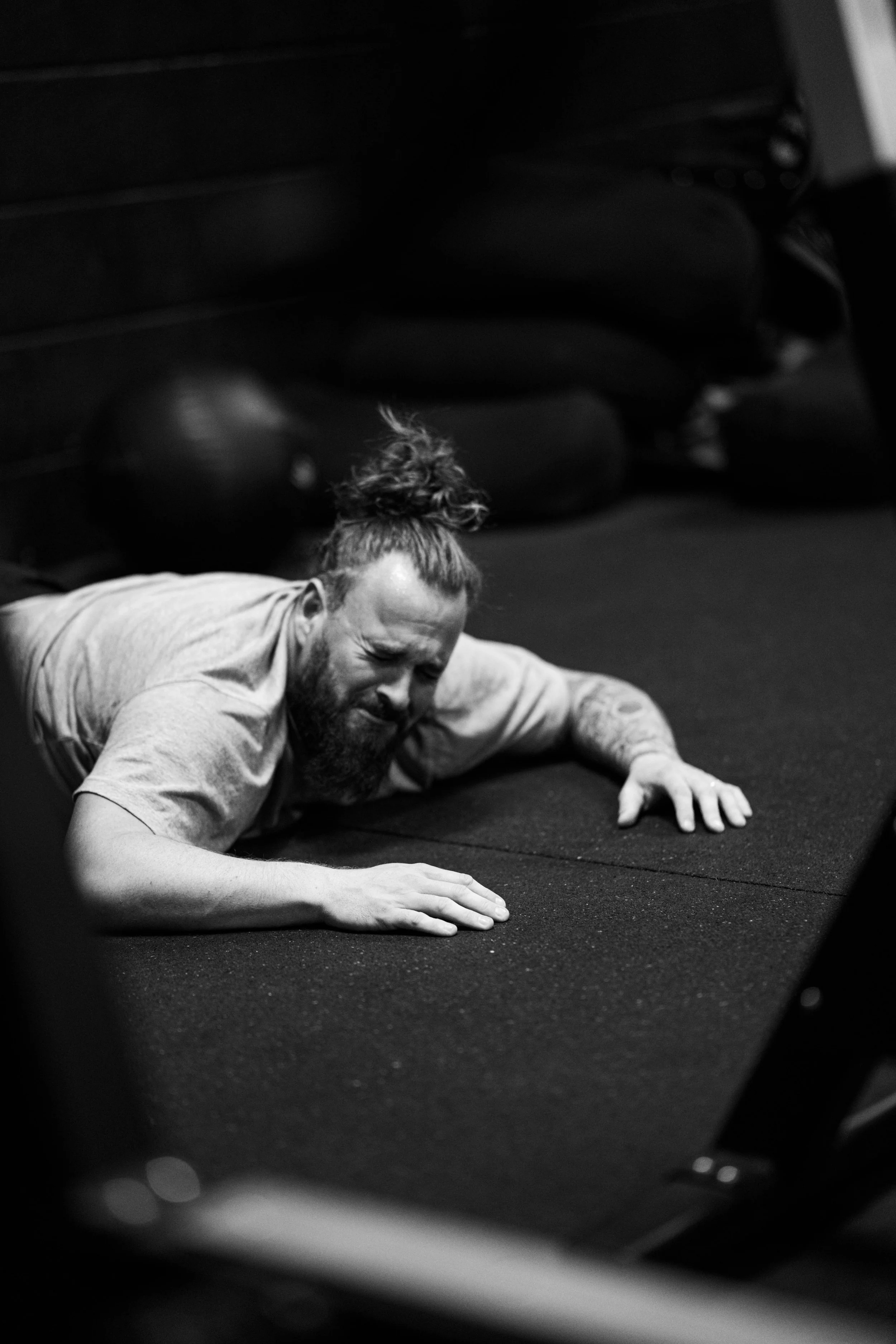
Don't get me wrong, being fit in meaningful ways is one of the greatest investments you could ever make. It improves almost every part of your life. Getting fit should be a priority for everyone. But getting fit when you are not fit seems daunting. Thinking about the discomfort and the effort required, the soreness, the work, and the planning deter most people. And yet, even if they get through that and manage to come up with a plan, the realization that others will see them as unfit compounds every other hurdle. And most stop here.
Being out of shape is the single highest-leverage position you will ever occupy in your fitness life. It is a window — short, exponential, and almost universally squandered because the people inside it are too embarrassed to use it.
The biggest advantage you have when you're trying to get fit from "off the couch" is that you are not impressive. Nobody is watching. Nobody has expectations. You are free. And most people throw that away in the first session.
Why is being out of shape an advantage?
Because no one is watching, and no one cares.
I can't tell you how many times someone has told me they want to train with us, but they need to get into shape first. The reasoning is always the same — they don't want to show up looking like they look. They fear the judgement of others recognizing their past, poor decisions on fitness. They want to arrive already fit so the work in front of everyone is just the polishing.
This is backwards. The reason to come train is not to demonstrate that you accumulated fitness on your own. Everyone already knows you're out of shape. There are obvious signs — the groan when you stand up from a chair, or how you get winded carrying groceries up the stairs. The people you're embarrassed in front of know you are out of shape already and they were once where you were. The embarrassment you feel is self-inflicted. I can't speak for everyone, but I don't care how fit someone is. Who I enjoy training with are people who want to become better, and they act on it, no matter what level they are at.
Being out of shape is prime real estate for exactly the reason you wish it weren't: because no one else cares. Which means you can actually do what you need to do to get better, without performing. It reminds me of this general rule: you can't impress a rich person by buying things. To the uber wealthy, buying things to impress others is the opposite of what makes you wealthy. The only people that are impressed by materialism are idiots and the poor. Fit people are very similar. They aren't impressed by how much risk you take in proving you are fit. The fit are impressed by the work ethic it takes to get and continue to be fit.
The returns at the start are exponential, and short.
Untrained systems respond to everything.
When you're out of shape, anything more than what you're currently doing is improvement. Walk more: more fit. Do one set of push-ups: stronger. Add protein: leaner. Take five deep breaths a day: better lung function. Go to bed earlier: improved recovery. The returns up front are exponential, and you will never have this leverage again.
The physiology backs this up. Sedentary populations show 20-40% strength improvements in the first eight weeks of training, and the majority of those early gains are neurological — your nervous system learning to recruit motor units it had stopped asking for, not new muscle being built. VO2max responsiveness follows the same pattern. The lower your starting capacity, the higher your responder rate and the larger your absolute gain. The fittest people in the world fight for 1-2% improvements over months. You can produce that in a week and you don't have to be clever about it.
There is no way to mess this up at the start — the one surefire way to fail is to start too hard. To pretend that you are fit. The bar is on the floor. Stepping over it is improvement. The leverage is real and it is short.
What program should a beginner or returning athlete follow?
None of them. Not as written.
Every program on the market — beginner, intermediate, advanced — is built on an assumption the program itself can't verify: that you can complete it. Programs are static. You are not. A program can't see that your shoulder is cranky today, that you slept four hours, that the warm-up already took more out of you than the program assumed it would. It just keeps prescribing.
For a new person or a returning athlete, this is the trap. You pick a program, you try to finish the session as written, and you either grind through work your tissue can't absorb or you quit because you "failed" the day.
The fix is simple: pick any program you like. Then ignore its completion criteria.
Set a timer. Train for 30 minutes. Stop when it goes off, wherever you are.
This is the only rule. You're not trying to finish the session. You're trying to train for 30 minutes and see what happens. Whatever you got through, that's the session. Three exercises, half of one, the warm-up and one working set — doesn't matter. The timer is a rev limiter, not a goal.
This does two things at once. It takes the focus off accomplishing a to-do list, which is the wrong frame for someone whose job right now is to build capacity, not to perform. And it puts a ceiling on the damage a bad day can do — you can't overshoot what your tissue can handle if the clock pulls you out. Do this for 3-4 weeks and then add 10-15 minutes. After 8-12 weeks, consider a full hour or trying to finish sessions. By this time you will have a real handle on what you can handle or can't, and this is the most important aspect when first developing: a sensitivity to the work and the cost.
Three sessions a week. Maximum.
Not four. Not five. Three, with a day between each. The day between is not wasted — it's the entire point. You need that day to feel what recovery actually is. Most people have never paid attention to it. You're trying to learn the signal: what does a day-after-training body feel like, what does two days feel like, when does soreness peak, when does it clear. That signal is the most important data you'll collect in your first six months because it tells you how you are adapting. Training to get fit is not dictated by how much training you can do, but what you can recover from.
On the off days: 30 minutes of general activity. No formal exercise.
Hike. Walk. Swim. Yoga. Bike to the store. Garden. Whatever moves you for 30 minutes without being "a workout." The point isn't fitness — you're already getting that from the three sessions. The point is to stay in motion, accumulate low-grade tissue stimulus, and keep your relationship with your body active on non-training days.
That's the whole plan. Three 30-minute capped sessions. Three 30-minute general activity days. One day genuinely off. You will want to do more. Don't. The leverage is in the minimal dose.
Why do formerly fit people have a harder time returning?
There are two starting points, and one is harder than people think. Either you've never been fit and you're starting, or you used to be fit, you let it go, and you're coming back. Most people assume the second is easier. You have a knowledge base. You've done it before.
The opposite is true. The former athlete has more problems than the person starting from scratch, and the problems are layered.
The first is ego. You try to prove you were fit. You jump to the weights and intensities you used to handle. Same mistake as the beginner — except amplified, because your nervous system remembers what your tissue can't support anymore. You have neurological memory and atrophied connective tissue. You can technically produce forces your body can no longer absorb.
The second is biological, and it's the part almost no one talks about.
What's actually happening in detrained tissue?
The system you used to have is not the system you have now, even if it still feels like it.
Detraining produces a cascade of measurable changes. Capillary density drops. Mitochondrial volume falls. VO2max can decline 4-14% inside the first month of inactivity and continues to fall over the months that follow (Mujika & Padilla 2000). Tendon and connective tissue cross-sectional area decreases. Resting stiffness changes.
The most disorienting change is fiber type expression. Sedentary tissue tends to drift toward fast-twitch dominance, probably as a survival adaptation — the body prioritizes the ability to produce force in an emergency over the ability to sustain output. Which means as a returning athlete, you can still lift close to what you used to lift. You just can't recover from it. The ego amplifies the drive to expose yourself to high loads because you've felt that success before.
This is the trap. Your nervous system is intact. Your motor patterns are intact. Your maximal force production is closer to your old self than anything else in your physiology. But the supporting tissue — tendons, ligaments, capillary networks, mitochondrial machinery — has degraded on a different timeline. You write neurological checks the collagen can't cash. Selye called this the alarm phase: an acute load applied to a system that hasn't built resistance-phase capacity yet (Selye 1936). The former athlete spends their first month producing alarm-phase loads at intermediate-athlete intensities.
Injuries show up in the first few weeks. Motivation collapses. The whole thing dies on frustration, and the story the athlete tells themselves is I guess I'm just done. They're not done. They skipped the rebuild and went straight to the performance.
Connective tissue remodels slower than muscle. Tendon CSA changes lag muscular recapture by 6-12 weeks under load. This is why the 30-minute cap matters even more for the returning athlete than for the beginner. The beginner's tissue is naive and slow to respond, and they have a built-in governor in their CNS. The returning athlete's nervous system is fast and lying to them.
Starting from scratch is cleaner than coming back.
Nothing is fighting you.
Novel stress means a strong response from small doses. There's no working memory arguing with the present moment. You're building patterns, not negotiating with the ghost of who you used to be. It's not easy, but it's straightforward.
Former-athlete energy is not straightforward. It's a negotiation with a body that no longer agrees with the brain. The brain has the old map. The body is operating on the new terrain. Every session is a translation problem.
For both populations, the move is the same: let go of what anyone else thinks. Stop performing. Embrace being unfit. It is, genuinely, the greatest position you'll ever be in to actually get fit.
You just have to be willing to not be impressive on the way there.
TL;DR
Being out of shape is the highest-leverage position in your fitness life. No one is watching, no one cares, and the returns on small inputs are exponential.
Untrained populations gain 20-40% strength in the first eight weeks, mostly neurological. The surest way to fail is to start too hard and pretend you're fit.
No program is appropriate as written for a new or returning athlete. Pick any program, cap it at 30 minutes, three times a week, with 30 minutes of general non-formal activity on off days. Progress the cap after 3-4 weeks.
Training is not dictated by how much you can do. It is dictated by what you can recover from. The off day is where you learn that signal.
Former athletes have a harder time than total beginners. Neurological memory recovers faster than connective tissue, so they produce forces their tendons can no longer absorb. The 30-minute cap matters more for them, not less.
